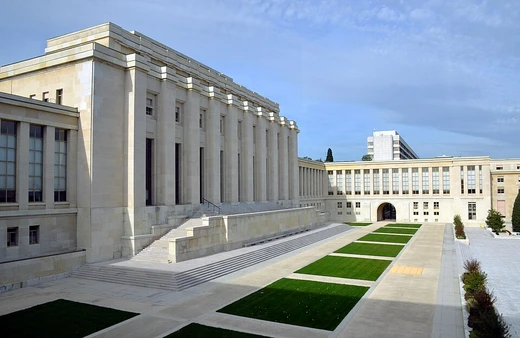
International Council on Monuments and Sites
Professional association for conservation of cultural heritage places worldwide.

The International Council on Monuments and Sites (ICOMOS), also known by its French name Conseil international des monuments et des sites, is a global professional body dedicated to safeguarding cultural heritage. Its origins trace back to the 1931 Athens Conference on the restoration of historic buildings, organized by the International Museums Office, which first introduced the idea of international heritage. The organization itself was established in 1965 in Warsaw, following the 1964 Venice Charter—formally the International Charter on the Conservation and Restoration of Monuments and Sites—which was adopted at the Second Congress of Architects and Specialists of Historic Buildings. The same congress that adopted the Venice Charter also founded ICOMOS to implement it, and today the council advises UNESCO on World Heritage Sites. Its headquarters are in Charenton-le-Pont, France.
As of 2024, ICOMOS counts approximately 11,000 individual members across more than 130 countries and territories, supported by 110 national committees and over 30 international scientific committees. Membership is restricted to qualified professionals in conservation-related fields, such as landscape architects, architects, archaeologists, anthropologists, town planners, engineers, heritage administrators, historians, art historians, palaeontologists, or archivists, with rare exceptions. ICOMOS is also a joint founding member of the Blue Shield, an organization that protects cultural heritage from war and natural disasters, alongside ICOM, IFLA, and ICA.
The structure of ICOMOS includes national committees (NCs), which individuals and institutions join, and international scientific committees (ISCs), where experts in specific heritage conservation fields exchange ideas. Leadership consists of a president, five vice-presidents, a secretary-general, and a treasurer, all directly elected by the General Assembly. The Assembly also elects twelve additional members to the Executive Committee, and five more are co-opted to represent underrepresented regions or expertise. The advisory committee—composed of national committee chairs, ISC presidents, and the ICOMOS president—advises on policy and program priorities. Past presidents also serve on the Executive Committee in an advisory capacity.
National committees are subsidiary bodies in UNESCO member countries, bringing together member
- founded
- 1965
- headquarters
- Charenton-le-Pont, France
- membership
- approximately 11,000 individual members in over 130 countries and territories (as of 2024)
- national_committees
- 110 (as of 2024)
- international_scientific_committees
- over 30 (as of 2024)
- field
- cultural heritage conservation and protection
- known_for
- Advisory body to UNESCO on World Heritage Sites; joint founder of the Blue Shield
Lore & Background
The idea behind ICOMOS dates to the Athens Conference on the restoration of historic buildings in 1931, organized by the International Museums Office. The Athens Charter of 1931 introduced the concept of international heritage. In 1964, the Second Congress of Architects and Specialists of Historic Buildings, meeting in Venice, adopted 13 resolutions. The first created the International Charter on the Conservation and Restoration of Monuments and Sites, better known as the Venice Charter; the second, put forward by the Congress itself, created ICOMOS to carry out this charter.
ICOMOS is composed of national committees (NCs) and international sc
Reader's Guide
ICOMOS is significant as the primary professional and scientific adviser to the UNESCO World Heritage Committee on all aspects of cultural heritage. Since 1972, it has been one of three formal advisory bodies to the World Heritage Committee, responsible for evaluating all nominations of cultural properties to the World Heritage List based on criteria such as outstanding universal value, authenticity, management, and conservation. Its evaluations involve extensive consultation among its membership and expert on-site missions, resulting in detailed recommendations submitted to the World Heritage Committee annually.
Beyond evaluation, ICOMOS prepares reports on the state of conservation of inscribed World Heritage properties and advises the UNESCO World Heritage Centre on technical assistance requests. Its documentation center in Greater Paris houses a major resource on cultural heritage, including bibliographic and graphic document databases. The organization also awards the Piero Gazzola Prize every three years to individuals or groups who have contributed to its aims. Through its national committees, international scientific committees, and working groups, ICOMOS advances knowledge and practice in cultural heritage protection, conservation, and restoration globally.
Did You Know?
- ICOMOS was founded in 1965 in Warsaw as a result of the Venice Charter of 1964.
- ICOMOS is a partner and founding member of the Blue Shield, which protects cultural heritage threatened by war and natural disasters.
- The Piero Gazzola Prize, established in 1979, is awarded every three years to an ICOMOS member who has contributed to the organization's aims.
- ICOMOS has over 12,000 individual members in over 130 countries and territories as of 2026.
Frequently Asked Questions
What is the International Council on Monuments and Sites?
ICOMOS is a worldwide professional organization dedicated to the protection and conservation of cultural heritage sites. It was established in 1965 in Warsaw and is headquartered in Charenton-le-Pont, France.
What role does ICOMOS play in heritage conservation?
The organization brings together conservation professionals to advise on the preservation of monuments, sites, and cultural landscapes globally. It operates through a network of national committees and specialized scientific committees that address specific heritage topics.
Where did ICOMOS come from historically?
The concept of international heritage protection was first raised at the 1931 Athens Conference on restoring historic buildings. ICOMOS was formally created in 1965 in Warsaw, building on the principles laid out in the 1964 Venice Charter.
How big is ICOMOS's membership?
As of 2024, the organization counts roughly 11,000 individual members spread across more than 130 countries and territories. It also maintains 110 national committees and over 30 international scientific committees.
Why does ICOMOS matter for cultural heritage?
It serves as the primary global professional body linking conservation experts, governments, and communities working to protect heritage places. Its advisory and scientific work helps shape how nations approach the preservation of their built and natural cultural landscapes.
More in International Organizations And Agreements 1-24
Spotted an error? Know more?
This is a living reference — every entry is fact-audited, and reader corrections feed straight into our audit queue. Suggest an edit · See this site's audit record